
How the Iran Conflict Impacts Markets and Long-Term Investing
March 3, 2026
As widely reported, the U.S. and Israel have carried out military strikes against Iran, targeting its leadership, military assets, and nuclear infrastructure. Iran’s Supreme Leader has been confirmed killed, and Iran has responded with missile and drone attacks across the Middle East. President Trump has indicated that the objective of the operation, known as "Operation Epic Fury," is regime change in Tehran, with strikes anticipated to continue for weeks and U.S. troop casualties already reported.
The situation continues to develop quickly, and the well-being of civilians in the region and U.S. troops remains the foremost concern. That said, investors will understandably have questions about what these events mean for markets, oil prices, and their portfolios.
President Dwight D. Eisenhower once said that "plans are worthless, but planning is everything." Applied to today, the lesson is that specific geopolitical events are unpredictable, but the fact that they occur regularly is not. Building a well-structured portfolio and establishing sound financial plans is designed precisely to address this kind of uncertainty. While every event is unique, financial markets have successfully navigated countless wars, crises, and regional conflicts, including the U.S. operation in Venezuela earlier this year.
For long-term investors, the essential task is to keep geopolitical headlines separate from portfolio decisions. What are the key considerations as events continue to unfold?
The current strikes are the latest development in a long-running story
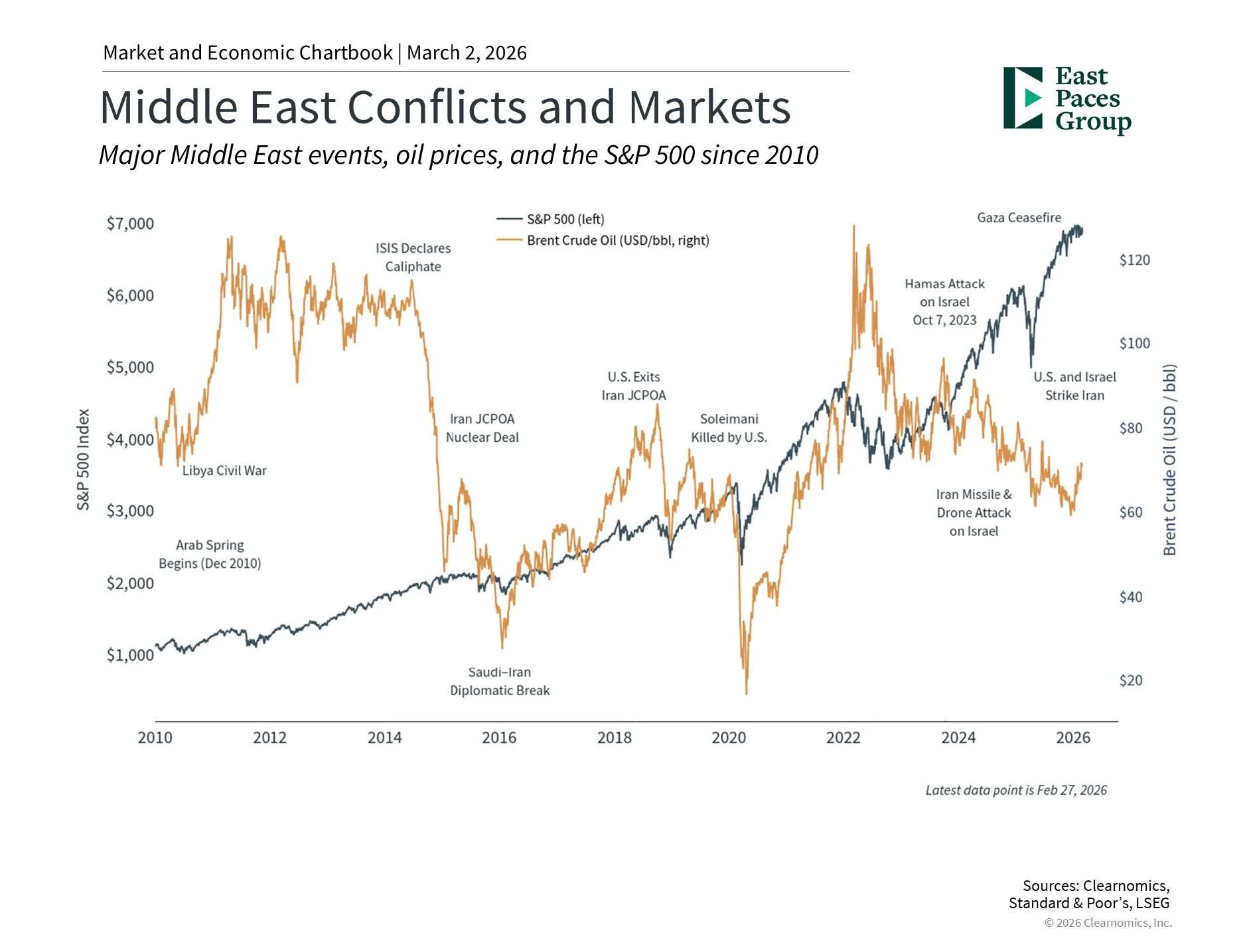
FIG 1.
Although the scale of the current strikes is considerable, tensions among the U.S., Israel, and Iran have been building for some time. This latest escalation follows a monthlong U.S. military buildup in the region, failed negotiations over Iran’s nuclear program, and President Trump’s pledge to support Iranian protesters who challenged the regime earlier this year.
To appreciate how we arrived at this point, it is helpful to look at the broader sequence of events:
Tensions between Iran and the West span decades, including the Iranian regime’s longstanding backing of Hezbollah and Hamas, which have been central to conflicts throughout the Middle East.
In 2019, Iran launched drone strikes against Saudi Arabia’s oil infrastructure, temporarily disrupting global oil production and stoking fears of a broader regional war.
Hamas’s October 2023 attack on Israel reignited regional conflict, eventually drawing in Hezbollah and intensifying tensions with Iran.
Last summer, Israel conducted a 12-day military campaign against Iran, targeting nuclear and ballistic missile programs in what was the most direct confrontation between the two countries in decades.
Earlier this year, Iranian protesters challenged the regime, with President Trump pledging U.S. support.
Negotiations over Iran’s nuclear program failed to produce an agreement. In recent weeks, a significant U.S. military buildup in the region indicated that a broader operation was being planned, culminating in the current strikes.
The scope of the latest strikes, including the targeting of Iran’s senior leadership, is wider than previous engagements. Nevertheless, history demonstrates that such conflicts are not always a catalyst for sustained market movements.
Energy Markets and the Strait of Hormuz
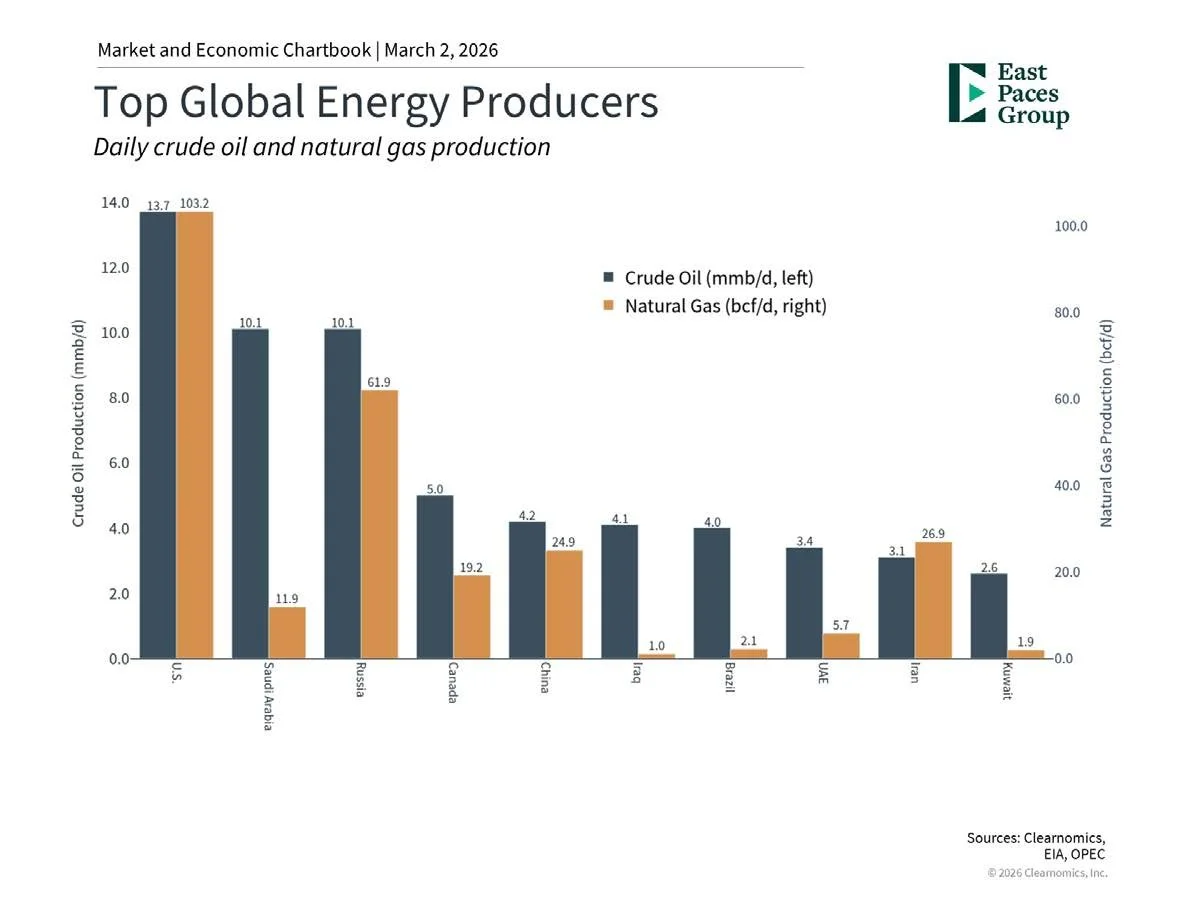
FIG 2.
For investors, global energy prices represent the most direct channel through which Middle East conflicts affect financial markets. Iran is a member of OPEC and produces approximately 3 million barrels of oil per day and 27 billion cubic feet of natural gas per day. The country also borders the Strait of Hormuz, the world’s most critical energy waterway. According to the U.S. Energy Information Administration, roughly one-third of all seaborne oil exports and one-fifth of natural gas transits this passage. Even the prospect of disruption to this vital route could have significant implications for global energy markets.
Oil prices had already been climbing in anticipation of the strikes. The immediate market reaction has seen oil rise further, with WTI reaching the low $70s and Brent crude trading just under $80 per barrel. While Western countries do not directly import Iranian oil, the global and fungible nature of oil markets means that any supply disruption can push prices higher.
Some context is warranted, however. Current oil prices remain well below the 2022 peak of nearly $128 per barrel, which followed Russia’s invasion of Ukraine. Today’s environment is meaningfully different. Since 2018, the U.S. has been the world’s largest producer of oil and natural gas, with domestic output exceeding that of major producers such as Saudi Arabia and Russia. While the U.S. remains connected to global energy markets, this level of production provides a meaningful buffer against supply disruptions.
It is also worth noting that oil prices are notoriously difficult to forecast. When Russia invaded Ukraine, many analysts expected prices to stay elevated for an extended period. Instead, prices stabilized and fell far sooner than anticipated. Likewise, the U.S. operation in Venezuela in January of this year caused a brief uptick in oil prices, but had limited lasting impact.
The case for remaining invested during geopolitical uncertainty
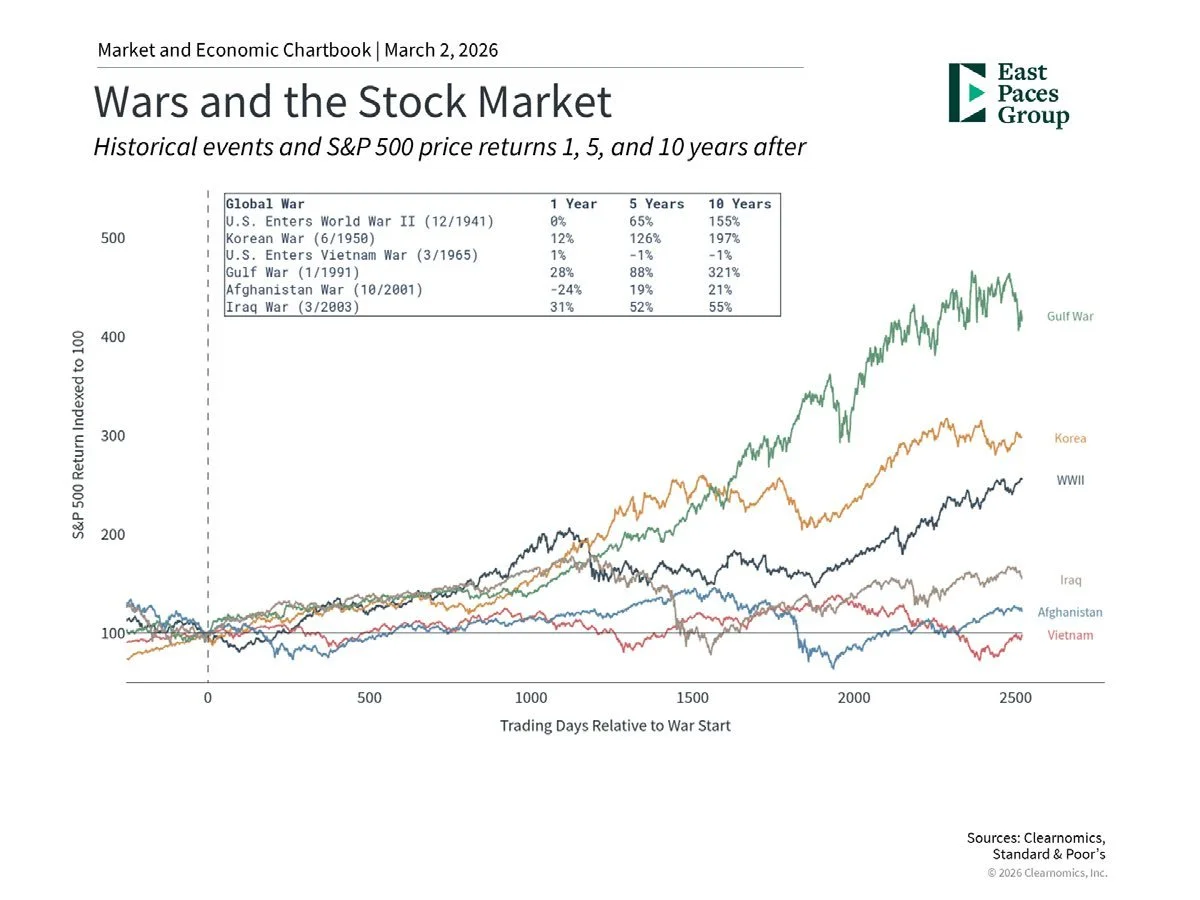
FIG. 3
For long-term investors, the most enduring lesson from past geopolitical conflicts is the importance of staying invested. It is natural to feel concerned when headlines describe military strikes, retaliatory attacks, and the prospect of a broader regional conflict. These events carry real human consequences and stand apart from the usual market discussions around earnings, valuations, and economic indicators.
The accompanying chart (FIG. 3) illustrates that markets have weathered even the most severe global events. From World War II to the Gulf War to the conflicts in Iraq and Afghanistan, markets experienced short-term volatility but were ultimately guided by underlying economic fundamentals. More recently, the conflicts between Russia and Ukraine, and between Israel and Hamas, generated significant uncertainty but did not fundamentally alter the broader market trajectory.
It is also worth noting that Iran has a minimal direct presence in most investment portfolios. The country has been subject to extensive sanctions for years, and its economy has suffered from severe hyperinflation, with the Rial experiencing a dramatic collapse in value. As a result, very few investors carry meaningful direct exposure to Iran in their asset allocations.
Markets may see increased volatility in the days and weeks ahead as the situation develops. Oil prices could climb further, and heightened uncertainty may weigh on investor sentiment. However, attempting to time these moves has historically proven counterproductive. Markets have demonstrated a capacity for unexpected recoveries, and missing even a handful of the strongest trading days can meaningfully diminish long-term returns.
The Bottom Line
The bottom line? The U.S. and Israeli strikes on Iran represent an important geopolitical development. However, history shows that investors who maintain diversified portfolios aligned with their long-term financial goals are best positioned to navigate periods of uncertainty.
Copyright (c) 2026 Clearnomics, Inc. All rights reserved. The information contained herein has been obtained from sources believed to be reliable, but is not necessarily complete and its accuracy cannot be guaranteed. No representation or warranty, express or implied, is made as to the fairness, accuracy, completeness, or correctness of the information and opinions contained herein. The views and the other information provided are subject to change without notice. All reports posted on or via www.clearnomics.com or any affiliated websites, applications, or services are issued without regard to the specific investment objectives, financial situation, or particular needs of any specific recipient and are not to be construed as a solicitation or an offer to buy or sell any securities or related financial instruments. Past performance is not necessarily a guide to future results. Company fundamentals and earnings may be mentioned occasionally, but should not be construed as a recommendation to buy, sell, or hold the company's stock. Predictions, forecasts, and estimates for any and all markets should not be construed as recommendations to buy, sell, or hold any security--including mutual funds, futures contracts, and exchange traded funds, or any similar instruments. The text, images, and other materials contained or displayed in this report are proprietary to Clearnomics, Inc. and constitute valuable intellectual property. All unauthorized reproduction or other use of material from Clearnomics, Inc. shall be deemed willful infringement(s) of this copyright and other proprietary and intellectual property rights, including but not limited to, rights of privacy. Clearnomics, Inc. expressly reserves all rights in connection with its intellectual property, including without limitation the right to block the transfer of its products and services and/or to track usage thereof, through electronic tracking technology, and all other lawful means, now known or hereafter devised. Clearnomics, Inc. reserves the right, without further notice, to pursue to the fullest extent allowed by the law any and all criminal and civil remedies for the violation of its rights.